
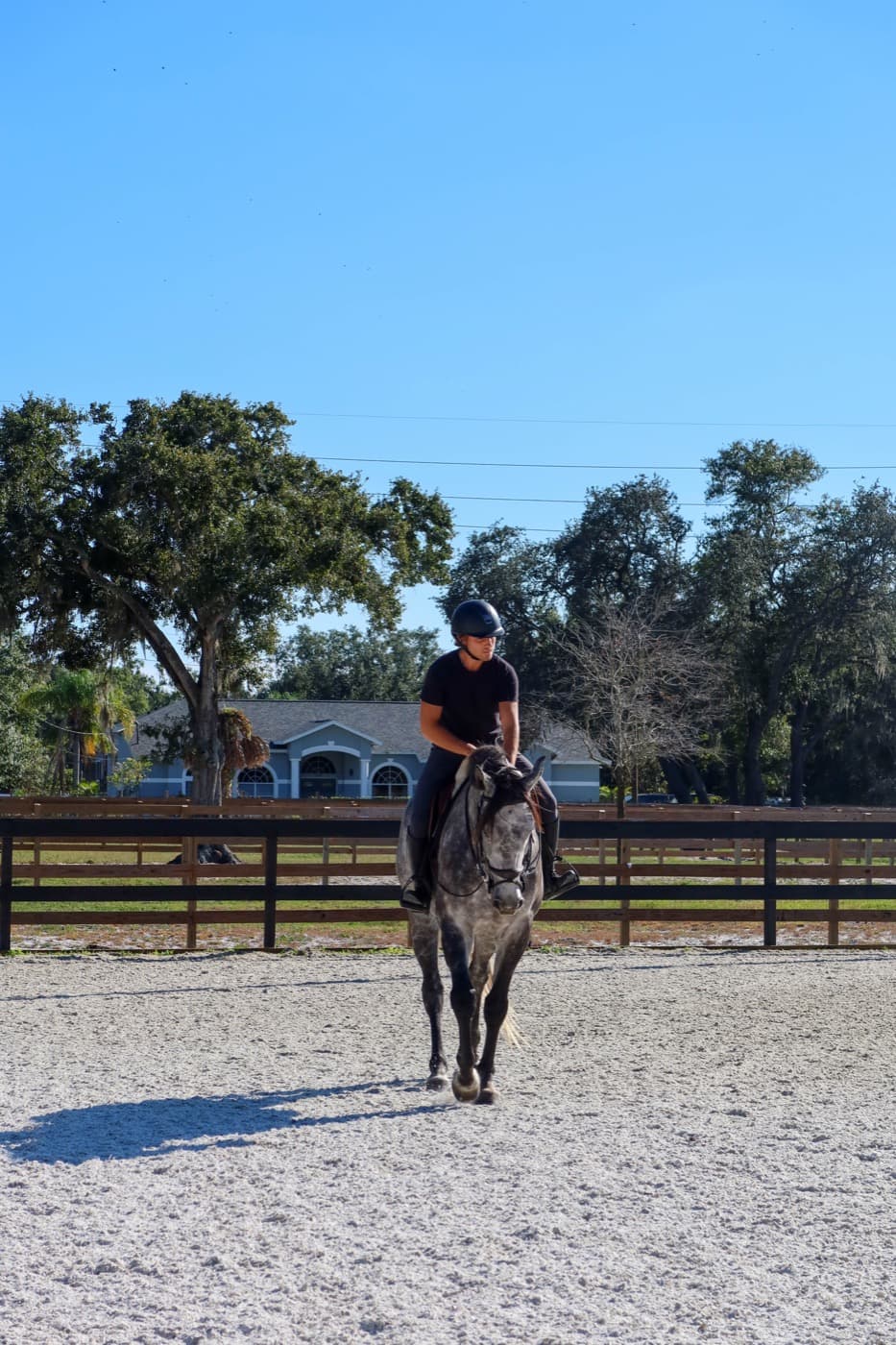
When dressage trainer Eliza Sydnor Romm surveyed more than 1,500 horse professionals and published the results with The Chronicle of the Horse, a blunt question got a blunt answer. Of the professionals who board horses, 60 percent said they lose money on it every month. Another 29 percent break even on each horse. Only 2 percent called it a good profit.
If you run a barn, you did not need a survey to tell you that. You can feel it in the checkbook. Full stalls, a waitlist, hay going out the door on schedule, and somehow nothing left at the end of the month.
I built a software company for exactly these businesses. On paper, that sounds backwards. Here is why I did it anyway.
Both sides of the aisle
I have been on horses since I was three years old. I did not come up with a horse of my own, so I earned my time in the saddle the way a lot of horse people do: as a working student. Mucking, feeding, wrapping, holding for the vet, whatever the day needed.
That work put me inside a lot of barns, and it gave me two vantage points most people never get at the same time. From the staff side, I saw how the day actually runs: the feed room whiteboard, the group texts, the blanket changes nobody wrote down, the owner doing invoices at the kitchen table long after night check. From the client side, I saw what boarders see: the board check goes out, the horse looks happy, and the quiet assumption is that the barn must be doing fine.
At seventeen, years of barn work finally led to a horse of my own. I trained him for a year and a half. Then I sold him, and I used that money to start OnStride™.
People ask why anyone would sell his horse to build software for an industry famous for not making money. The honest answer is that I had watched too many good horsemen run excellent barns and struggling businesses, and I did not believe the problem was the horsemen.
Where the money actually goes
Let me be straight about something first: I have never run a boarding operation myself. What follows is what I saw from inside them, barn after barn, and it lines up almost word for word with what owners say when the profitability question comes up on the forums.
Board is priced by folklore
Ask a barn owner how the board rate was set and the most common answer is some version of "it is what the barn down the road charges." Not cost per stall. Not hay plus bedding plus labor plus insurance plus utilities plus the tractor plus the fence boards that need replacing every single year. The going rate.
But the going rate was set by other barns pricing the same way, and plenty of them are quietly subsidizing board with lessons, training income, or an off-farm paycheck. When everyone prices off everyone else and almost nobody prices off actual costs, you get an entire market anchored below its own cost of production. That is how six in ten end up underwater without doing anything obviously wrong.
The extras quietly given away
Watch any full-care barn for a week and count the five-minute favors. A blanket swapped because the weather turned. A horse held for the farrier because the owner was at work. Meds given twice a day for two weeks after a vet visit. An extra flake at night check for the hard keeper.
Any one of them is nothing. But five minutes, times thirty horses, times every day of the year adds up to a part-time employee's worth of labor, and at most barns it is billed at exactly zero. Not because the owner decided to give it away. Because nobody wrote it down between the aisle and the office. The work was real. The revenue never existed.
The hours nobody counts as labor
Then there is the job after the job: building invoices from memory at the end of the month, chasing the boarder who is three weeks late, answering the same feeding question by text for the fourth time, digging for a Coggins when the hauler is already in the driveway. If the owner's own time went on the books at even a modest hourly rate, a lot of "break-even" barns would discover they are paying for the privilege of working there.
None of this shows up as one big loss. It shows up as a hundred small leaks, which is exactly why it goes unfixed. You cannot see it in the checking account. You can only see it in the numbers, and most barns have never had the numbers in one place.
The part software people will not tell you
Here is the honest take, from someone who sells barn software: software does not fix a broken price.
If your board rate is genuinely below your cost per stall, no app on earth makes that profitable. The fix is arithmetic and a hard conversation. Work out your real cost per stall, compare it to what you charge, and if the gap is ugly, plan a board increase and give proper written notice. That is a pricing decision, and it belongs to you, not to a piece of software.
What software does do is stop the leaks around a sound price. It catches the blanket change and the farrier hold at the moment they happen, so they end up on an invoice instead of in the goodwill column. It keeps the feed chart, the health papers, and the billing in one place, so the office work stops eating your evenings. And it shows you the one thing almost no barn can see today: what each horse actually costs you, next to what that horse actually pays you.
Try this for two weeks
Keep a note on your phone and log every unbilled extra: blanket changes, held horses, medicating, extra hay, the lot. Do not change anything yet, just write it down. At the end of two weeks, price the list at your own labor rate. Most owners who try this stop arguing about whether tracking matters.
See it working in a real barn.
A 45-minute walkthrough of OnStride™, tailored to your operation.
What knowing your numbers actually looks like
Forget dashboards for a second. In practice, knowing your numbers means you can answer four questions without guessing:
- What does one stall cost me per month, all in? Hay, bedding, labor, insurance, utilities, maintenance, and a share of the overhead nobody assigns to anything.
- What does each horse actually generate? Base board plus every extra that horse consumed this month, captured when it happened, not reconstructed at invoice time.
- Which horses am I subsidizing? Some horses will always cost more than they bring in. That can be a fine choice. It should be a choice you are making on purpose.
- How many hours of admin am I donating? If the answer is fifteen hours a week, that is a cost line, whether or not it ever hits a ledger.
You can get to these answers with a spreadsheet and discipline. Plenty of owners do. I built OnStride™ for the ones who tried that and watched it collapse under real barn life, because the aisle is where the information lives and the office is where the spreadsheet lives, and the walk between them is where the money disappears.
Why I built it anyway
Because the losses are not a law of nature. Boarding margins are brutal, but the three biggest reasons barns lose money, pricing by folklore, giving away tracked work, and donating uncounted hours, are all fixable, and they all start with the same step: seeing the real numbers.
And because I think the people running these barns deserve better tools than a whiteboard, a group text, and a shoebox of receipts. I spent years working alongside them. I sold my own horse to build for them. That only makes sense if you believe, as I do, that most barns are one honest look at their numbers away from a very different business.
The short version
- A survey of more than 1,500 horse professionals, published by The Chronicle of the Horse, found that most boarding operations lose money and only a sliver turn a real profit.
- Price from your cost per stall, not from the barn down the road. If you have never calculated it, that is the first job.
- Track every extra for two weeks. Then decide what to bill, what to bundle into board, and what to knowingly give away.
- Count your admin hours as labor, because they are.
- Whatever tool you use, paper, spreadsheet, or software, the goal is the same: know what each horse costs and what each horse pays. Everything else follows from that.